
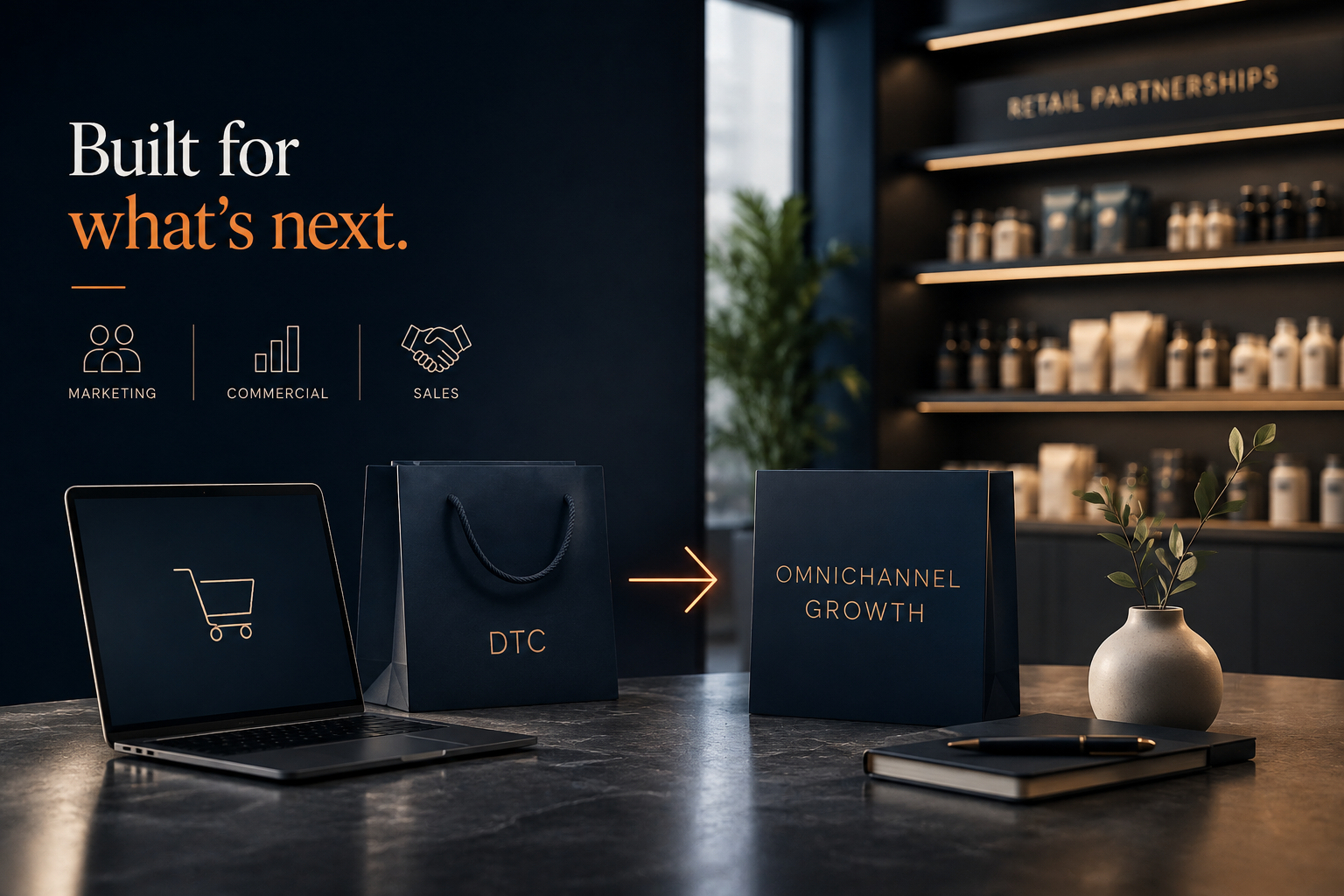
There is a specific moment that many consumer brand founders recognise, even if they struggle to name it precisely. The DTC operation is working. Revenue is growing, the customer acquisition model is proven, and the brand has genuine momentum. Then comes the conversation about retail. A buyer expresses interest. A wholesale opportunity appears. And suddenly the question is not whether to grow, but how, and with what team.
This is the transition point. And it is happening right now, visibly and repeatedly, across Pet, Health and Wellness, Food and Beverage, and Beauty and Personal Care. These are categories where DTC built the foundation, where brands proved their concept, found their audience, and refined their proposition without the complexity of retail infrastructure. That is a real achievement, and it deserves to be treated as one.
But DTC success does not automatically translate into omnichannel capability. The team, the skills, and the ways of working that built your direct business were designed for a specific set of challenges. Retail and wholesale present a different set entirely. The instincts that served you well, moving fast, optimising performance, owning the customer relationship end to end, are not the instincts that retail demands. Buyers want consistency, commitment, and commercial rigour. The pace is different, the margin logic is different, and the consequences of getting it wrong are felt across the relationship, not just in a single campaign.
The Growth and Marketing team deserves its credit. It built the brand. It found the customer, proved the proposition, and turned paid acquisition into a repeatable engine. The product-market fit that now makes retail conversations possible? That came from this function. The loyal customer base, the retention metrics, the brand equity that gives a buyer reason to listen: all of it traces back to the work this team has done.
That is not a small thing. In categories like Health and Wellness, Pet, and Beauty and Personal Care, where DTC has been the proving ground for a generation of challenger brands, Growth and Marketing has been the function that made the business real. Performance marketing, conversion optimisation, lifecycle campaigns, brand storytelling built for a direct audience. These are genuine, hard-won capabilities.
But they are built for a specific context. The skills that drive DTC growth, targeting, testing, optimising a customer journey you control end to end, do not map cleanly onto what retail and wholesale demand. Negotiating a listing with a major grocery account is not a performance marketing problem. Managing a buyer relationship across a twelve-month promotional calendar is not a retention challenge. Running a wholesale profit and loss account, where margin structures, trade terms, and retailer expectations operate on entirely different logic, requires a different kind of commercial thinking altogether.
None of this reflects badly on the Growth and Marketing team. It reflects the structural reality of what the function was built to do. DTC and omnichannel are not the same discipline. Expecting one team to carry both, without bringing in the right commercial and operational capability alongside them, is where the transition starts to strain.
Securing interest from a major retailer feels like a milestone. And it is. But interest is not a listing, and a listing is not a profitable account. What sits between those two points is a set of commercial skills that most DTC-built teams simply do not have, and have never needed to develop.
Retail and wholesale operate on entirely different terms from direct-to-consumer. Buyers at major grocery, pharmacy, or pet specialist chains are experienced negotiators working to their own category targets. They want to understand your range architecture, your promotional calendar, your margin position, and your commitment to in-store execution. If you walk into that conversation without someone who has done this before, you will either leave value on the table or agree to terms that quietly erode your profitability for years.
This is where a National Account Manager and, at the right stage, a Commercial Director become genuinely critical hires. Not because they are impressive titles to have on the org chart, but because the work they do cannot be improvised. Wholesale profit and loss management, promotional planning, range negotiation, and the ongoing maintenance of buyer relationships are all distinct disciplines. They require experience that takes years to build, and they are not skills that transfer naturally from performance marketing or DTC brand management.
The scenario plays out more often than it should. A brand in Health and Wellness or Food and Beverage gets a warm signal from a major retailer, moves quickly to secure the listing, and sends someone from the existing team to handle the negotiation. The listing is won, but the terms are unfavourable. The promotional commitments are heavier than anticipated. The margin, once trade spend and logistics are factored in, is thinner than the business can comfortably sustain. Twelve months later, the account is technically active but commercially difficult, and the buyer relationship has been shaped by a first impression that is hard to undo. The opportunity was real. The capability to convert it properly was not yet in place.
Most founders do not see the operational problem coming. They are focused on the commercial opportunity, which is entirely understandable. A retailer has expressed interest, a wholesale conversation is progressing, and the energy in the room is about growth. The supply chain conversation feels like something to sort out once the deals are done.
That instinct is expensive.
Adding retail and wholesale channels alongside DTC does not just increase volume. It changes the nature of the operational challenge entirely. You are no longer managing one fulfilment model. You are managing three simultaneously, each with different lead times, labelling requirements, minimum order quantities, and delivery windows. Retail buyers do not absorb your operational learning curve. Miss a fill rate target or deliver outside the agreed window and you will hear about it in ways that affect the relationship, and the margin.
Forecasting becomes genuinely harder too. DTC gives you relatively clean, real-time demand signals. Wholesale and retail introduce longer planning horizons, promotional uplift, and the kind of inventory decisions that, if you get them wrong, leave you either out of stock at the worst possible moment or sitting on capital you cannot move.
The structural risk is straightforward: hire commercial capability without the operational backbone to support it, and the commercial wins start to create operational failures. A National Account Manager who lands a major grocery listing is doing exactly what you hired them to do. If the supply chain cannot service that account reliably, the listing becomes a liability. Fill rate failures, late deliveries, and stock shortfalls do not just cost you margin. They cost you credibility with a buyer who had other options and will remember the experience when ranging decisions come around again.
The logic here is straightforward, even if it is rarely followed. Growth and Marketing comes first. It builds the DTC engine, achieves product-market fit, and gives you the data and brand equity to have a credible conversation with retail buyers. Without that foundation, nothing else holds. Commercial and Sales capability becomes the priority once retail and wholesale move from aspiration to active strategy. Not before. And supply chain and operational leadership needs to scale in parallel with commercial ambition, not in response to it.
That last point is where brands most often come unstuck.
Hiring a Commercial Director before you have a clear route to market is an expensive mistake. Not because the person is wrong, but because there is nothing yet for them to execute against. They will spend their first months building strategy in a vacuum, and the best ones will start to wonder whether the business is genuinely ready. Similarly, hiring a National Account Manager before you have worked out your channel positioning, your margin structure, or your retailer targets is not ambitious. It is premature, and it tends to produce frustration on both sides.
The opposite error is just as costly. Landing a major retail listing before your fulfilment operation can support the volume is not a growth moment. It is a reputational risk. Buyers have long memories, category reviews happen on a fixed cycle, and a brand that failed to deliver in year one is carrying that into year two’s ranging conversation. The sequencing matters because the consequences of getting it wrong are not always immediate. Sometimes they arrive quietly, six or twelve months later, in a buyer meeting that does not go the way you expected.
Growth and Marketing builds the foundation. It is the function that earns you the right to have a retail conversation, and it needs to come first. Commercial and Sales capability should follow once retail and wholesale are a genuine strategic priority, not a distant aspiration. Operations and Supply Chain leadership must scale in parallel with commercial ambition, not scramble to catch up after the listings are already live. Hiring in the wrong order is one of the most common and costly mistakes brands make at this stage of growth. And the sequencing logic holds across categories: whether you are in Pet, Health and Wellness, Food and Beverage, or Beauty and Personal Care, the transition from DTC to omnichannel follows the same structural pattern, even if the specific pressures vary by channel and retailer.
If your brand is approaching this transition, or already in the middle of it, the team question is not something you can defer. The pressure to move quickly is real, and so is the cost of getting it wrong.
What this piece has tried to make clear is that the value is not simply in knowing which roles to hire. It is in understanding the sequence: when Growth and Marketing has done its job and commercial capability needs to come in, and when the commercial pipeline is substantial enough that operational leadership has to scale alongside it, not scramble to catch up afterwards. Those timing decisions are where brands tend to get into difficulty, and they are rarely obvious from the inside.
Every brand’s transition looks slightly different. The pace varies. The retail channel matters. The category shapes the complexity. A Food and Beverage brand entering a major grocery multiple faces a different set of pressures from a Health and Wellness brand moving into specialty wholesale, even if the underlying sequencing logic holds.
At Acquire, we work across all three functions: Growth and Marketing, Commercial and Sales, and Operations and Supply Chain. We understand how they interact during this kind of transition, not just what each function looks like in isolation. That perspective tends to be most useful not when a business already knows exactly what it needs, but when it is working out the order, the timing, and what good looks like at each stage.
If you are navigating this transition and want to think through where your business is in that sequence, we would be glad to have that conversation. As a specialist talent partner across consumer categories, we work with brands at precisely this inflection point. Get in touch and let us talk through where you are.